Deschutes/Lockit, August 16th,’82
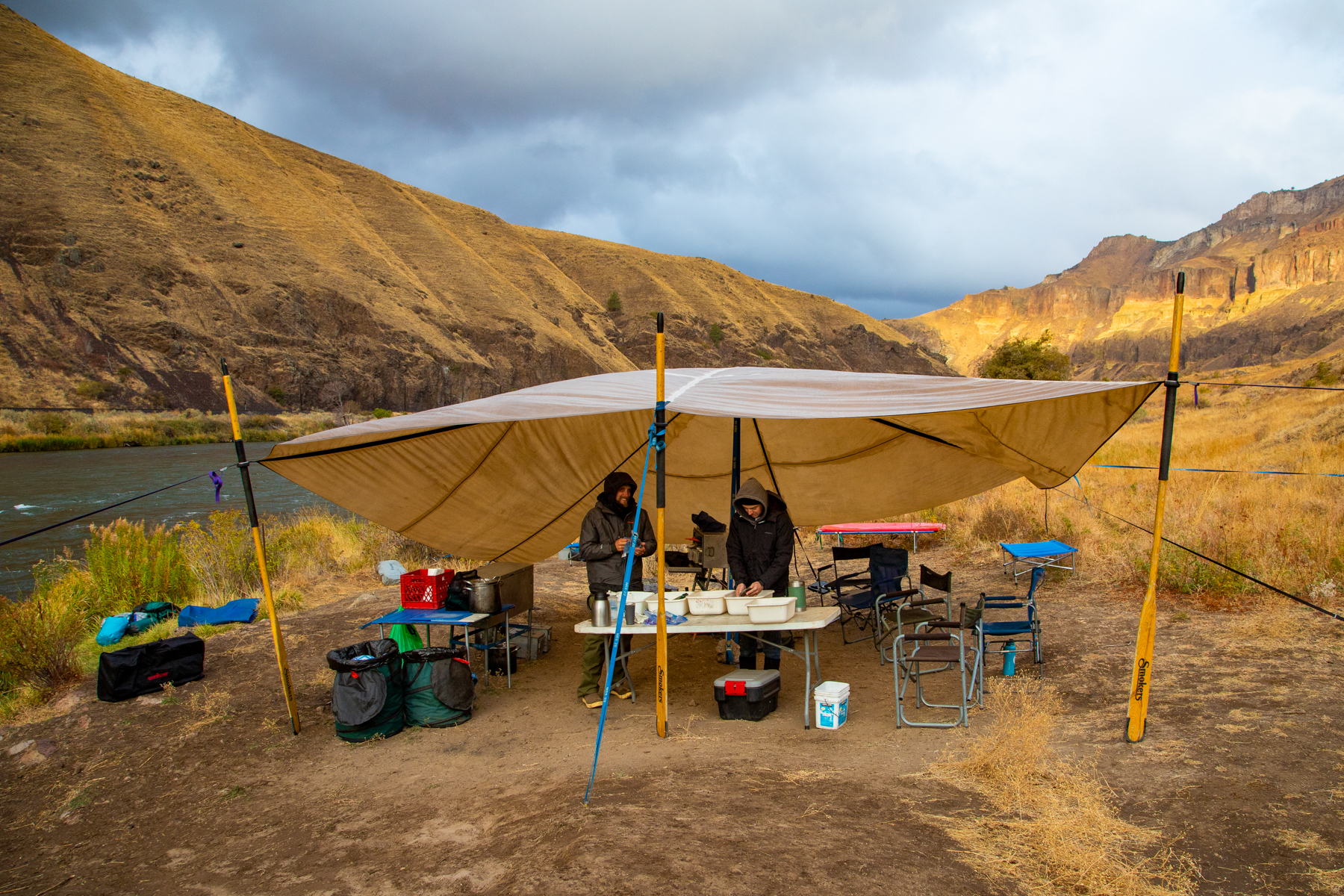
We are early walking in the evening sun, Don and I, hiking the old railroad grade down along the bend. Mike and Kenny hiked upriver to claim Steelie Flats before the jet boats did. This, the second trip down with these three and I’m stoked to have them back in my boat. Gordy’s people are fishing camp water. There is shade everywhere but here.
It’s a good crew, and the boys don’t mind the hundred plus heat. Kenny is co-owner of a fly ship in Reno. Mike owns an auto body shop there. Don Kemp is a neurosurgeon out of San Fran who fishes the winter-run Nor-Cal streams but says that fishing summers here is the absolute best.
Gordy has the hop farmers from in state who come every year, more as a hoot I think (and respite from the wives if I’m eavesdropping correctly), than any real desire to fish. They do seem to enjoy themselves on the water, but once they’ve got their evidence pics they spend more time working the wet bar than the water. Gord’s good with that at least, but man, give me greyhounds any day; they’re first to leave camp to maximize they’re chances and the last to return.
 Behind a weathered loading corral, a chipped, enamel cup floats in an old concrete cistern. I take two cans of Rainer Ale from my vest and drop them in. We drink from the spring and pick at the dusty blackberries. The sun is up still, barely an inch of it, emptying through a notch high up the west canyon wall. Directly cross the river the calvary is mounting up. A large jet boat encampment is stirring. We watch them load up the troops and motor off, both boats heading down river for the evening sesh, a good sign.
I think how the revolution of the earth strictly regulates our fishing. Steelies will not rise to the river’s surface into glaring desert sun, which is precisely where a fly man will want to tryst. Only in the twilight of morning and evening do we get our shot. Only a determined fisherman, certainly a spinner or spoon angler, can still prevail mid-day, but there is something very special about connecting with our quarry at the cusp of each other’s world.
Suddenly, the sun is down. A wash of shade floods down the bank and over the river, instantly transforming it into a metallic sheen reflecting a marbled palette of ochre, rust and dusty blue. Don slips slowly down the bank, careful not to loose a stone.
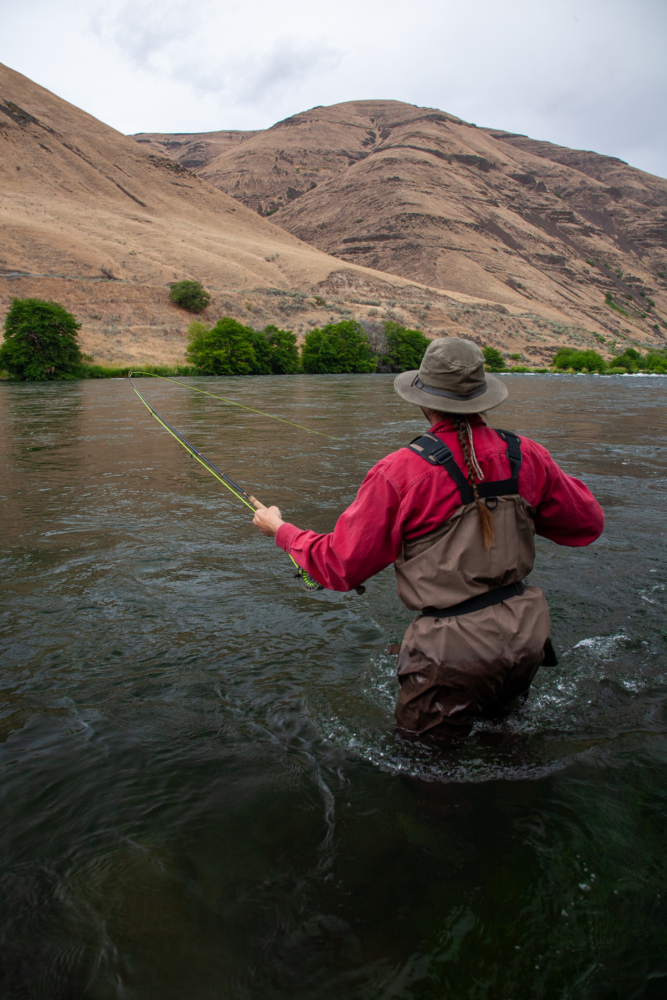
Obscured by Russian olive at the bottom of a loose scree slope, a bit froggy looking at first glance and a 9 out of 10 on the difficulty to fish scale, cramped and short and ending abruptly a rock ledge. Frankly, it is the antithesis of what fly fishermen are looking for. But Gordy turned me onto it when I was a rookie. It is fished with fly line held completely out of the water, the tip of the rod leading the fly like an orchestra conductor through oily, swirling currents.
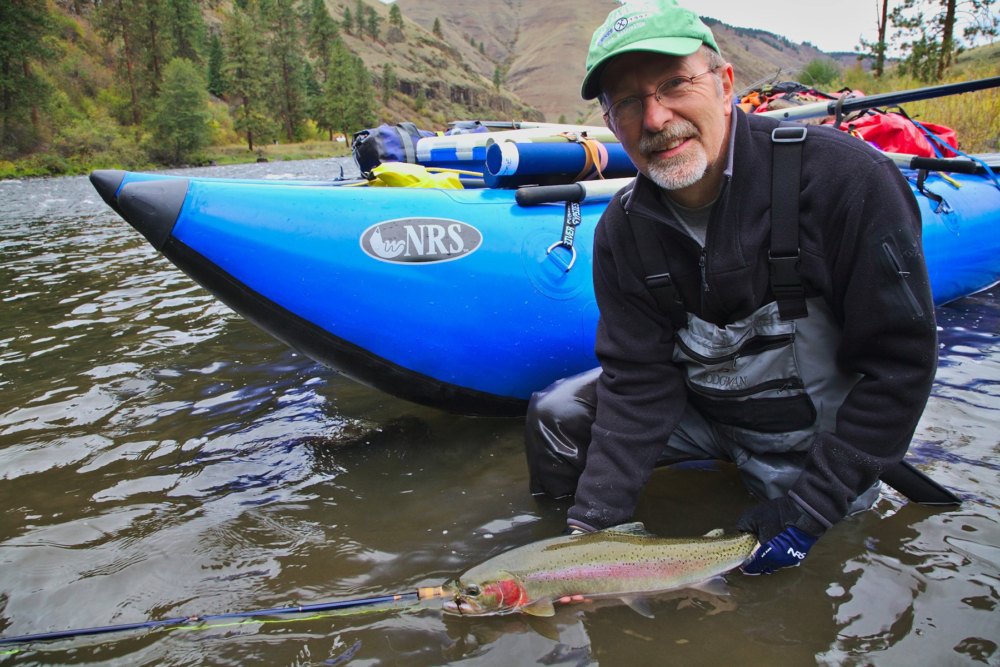
I see Don’s fish emerge from the void; the river is such a milky green that the first thing I see is the white of its mouth! I start to call out to warn Don, but as my own mouth opens there is a sudden boil where the fly had been, and his rod is jerked out of his hand and into the water. My mouth is still open as I watch Don dive in after it!
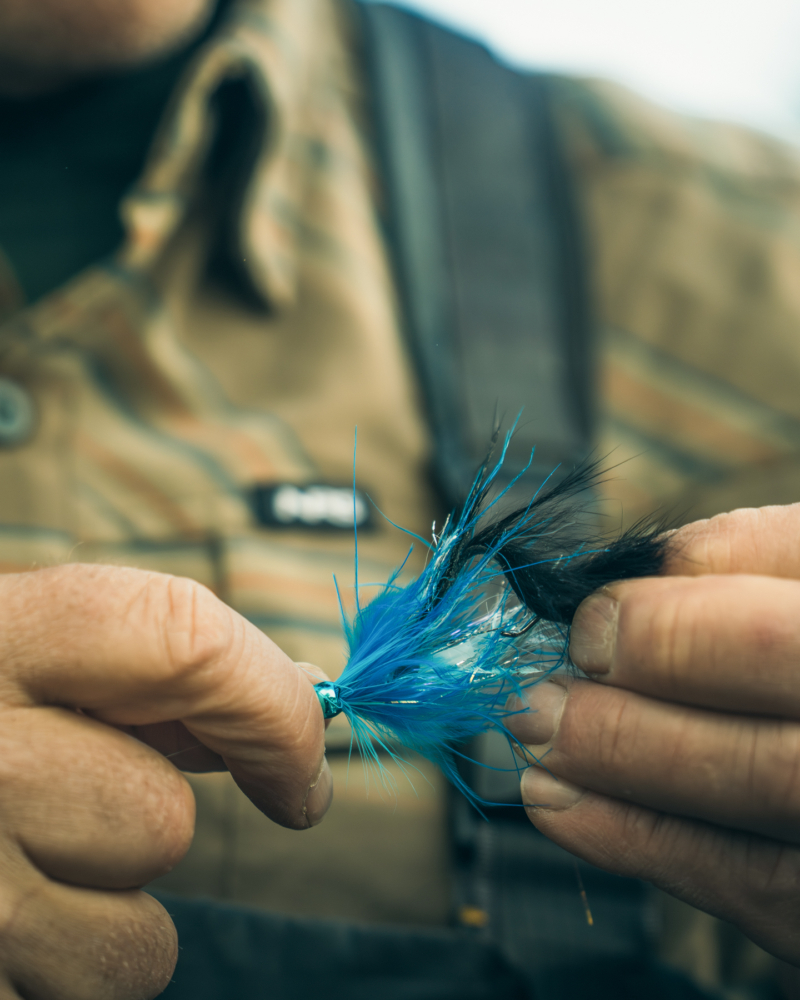
While Don is wringing out, I replace the beefy tippet with ten-pound Chameleon, dig out the bird’s nest and lighten the drag a skosh. I toss Don another fly. We both have a good, long laugh. It’s good day for a dip, at least. I felt bad, as it was my salmon reel I’d loaned him when his went south the first day out and I’d had the drag snubbed tight for some reason and forgot to check.
The run at the tail of the bend is an entirely different animal. Here the basalt stratum are laid down horizontally and the crystalline pillars lend a lovely, geometric quality to the current, rather like what I have imagined it might be like to swing a line over a sunken Greek ruins.
Plum lies are the seam against a hard channel along the far bank, and then the tailout. Steelies will hug this edge of the chute for relief from the current, then drift back into the calmer water of the pool to hold just in front of the line of rocks at the tail. I show Don the trick to wading it then take out my pipe and sit down on the bank and lean back against a boulder. Don wades out and works a long line that tickles the seam. Five minutes of this and a shout!
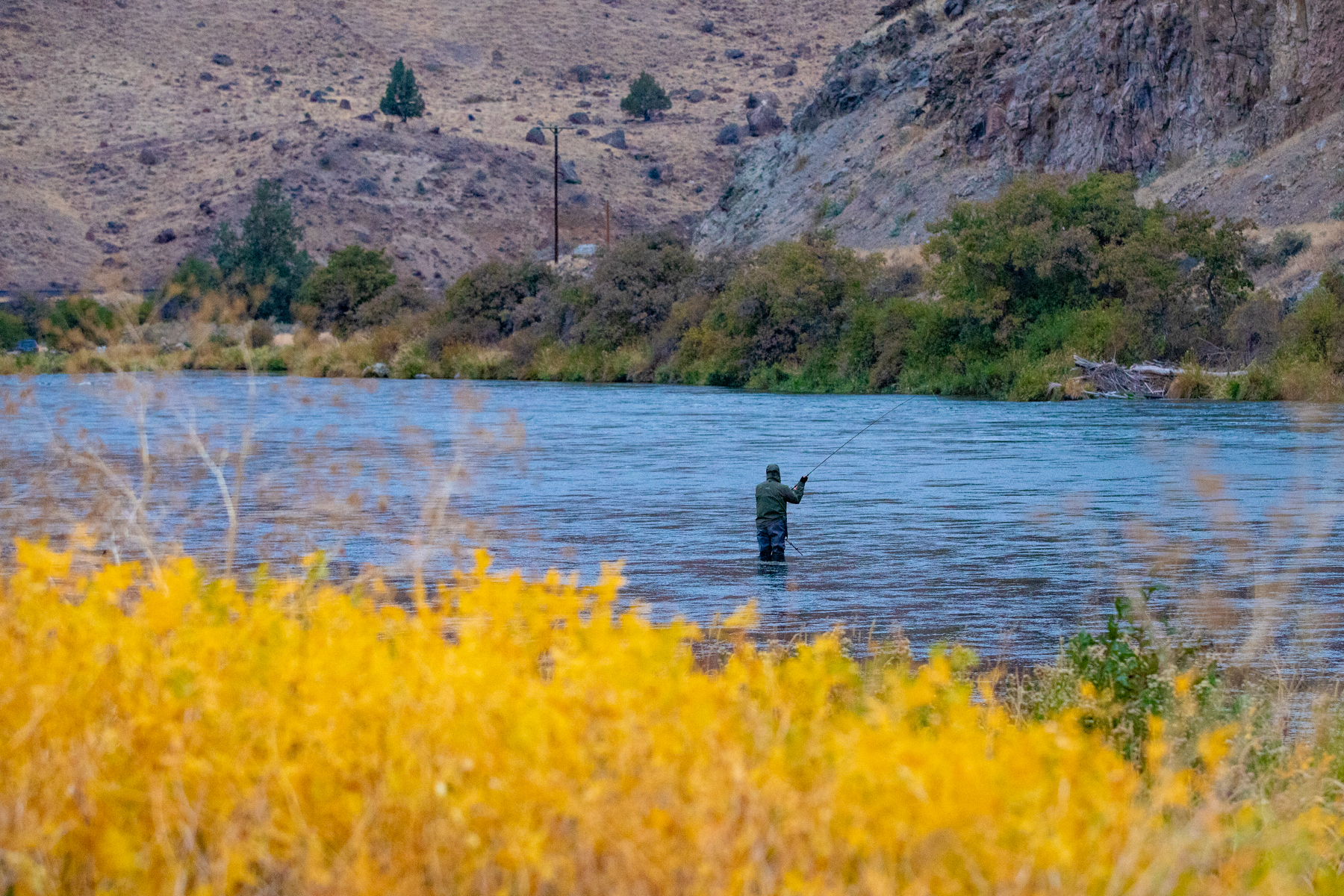
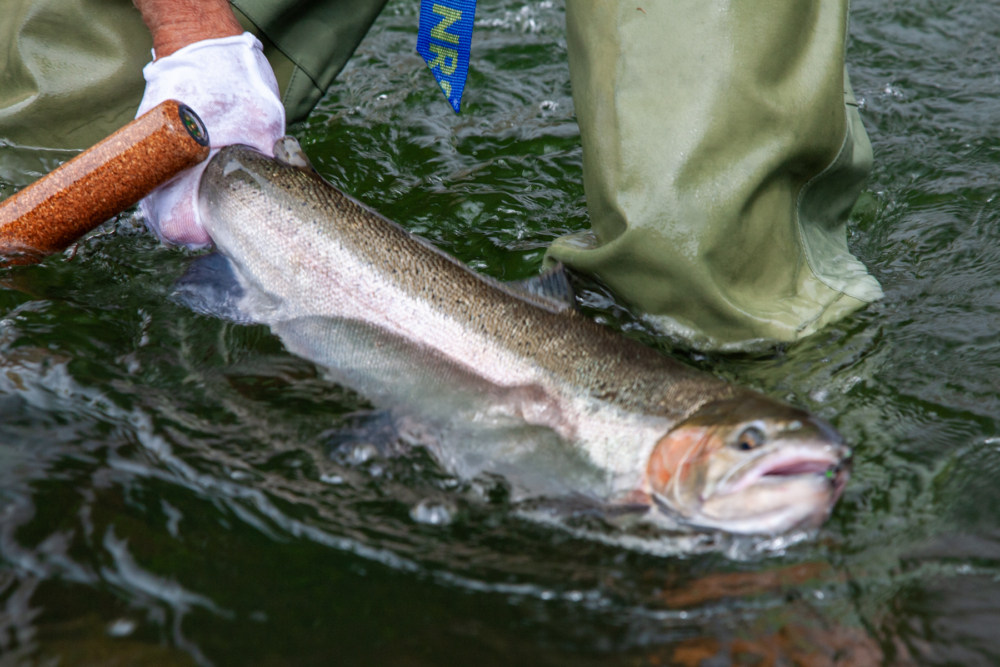
It is a decisive fish and shows Don no mercy. It peels off into the powerful currents in the chute, accelerates like a rocket and the hook pulls free! “Try the tail,” I call out. “You’ll have to wade all the way back here to fish it right.”
Don is in the sweet spot and has worked out a length of line that has his fly, a classic green-butt skunk, swimming slowly, gracefully, and tickling the edge of the rocks. Bingo, right on cue! A tight boil and Don sets; the fish holds a moment while the line catches up, then thrashes at the surface before darting through a channel in the rocks into the shallows below. Don hurries ashore, rod high to clear the rocks, splashing wildly, hustling along the bank and down into the riffle after it. I leave him to it.
Walking back in the dark together on the old railroad grade high above the river, Don tells me about this last fish. It felt bigger than most, he tells me. “I couldn’t do anything. Once I reached the deeper water I had to stop. I braked as hard as I could, but it never even slowed. Glad I tied that arbor knot well.”
“Being a neurosurgeon has its perks,” I jest. We have a good laugh at this. The air is warm still, but a fresh breeze lifts off the water. Bats dart overhead, stars wink beyond. We hear the whirr of nighthawk wings. At the corral, I pull two cold cans out of the cistern.
Across the river we hear a distant rumble that spells train. We prop our rods on the corral rail and walk over to the bank to watch the show. The metallic squeal of steel-on-steel echoes through the canyon. We turn to catch the play of light and shadow as the powerful locomotive halogen lamp paints the canyon walls in chiaroscuro.
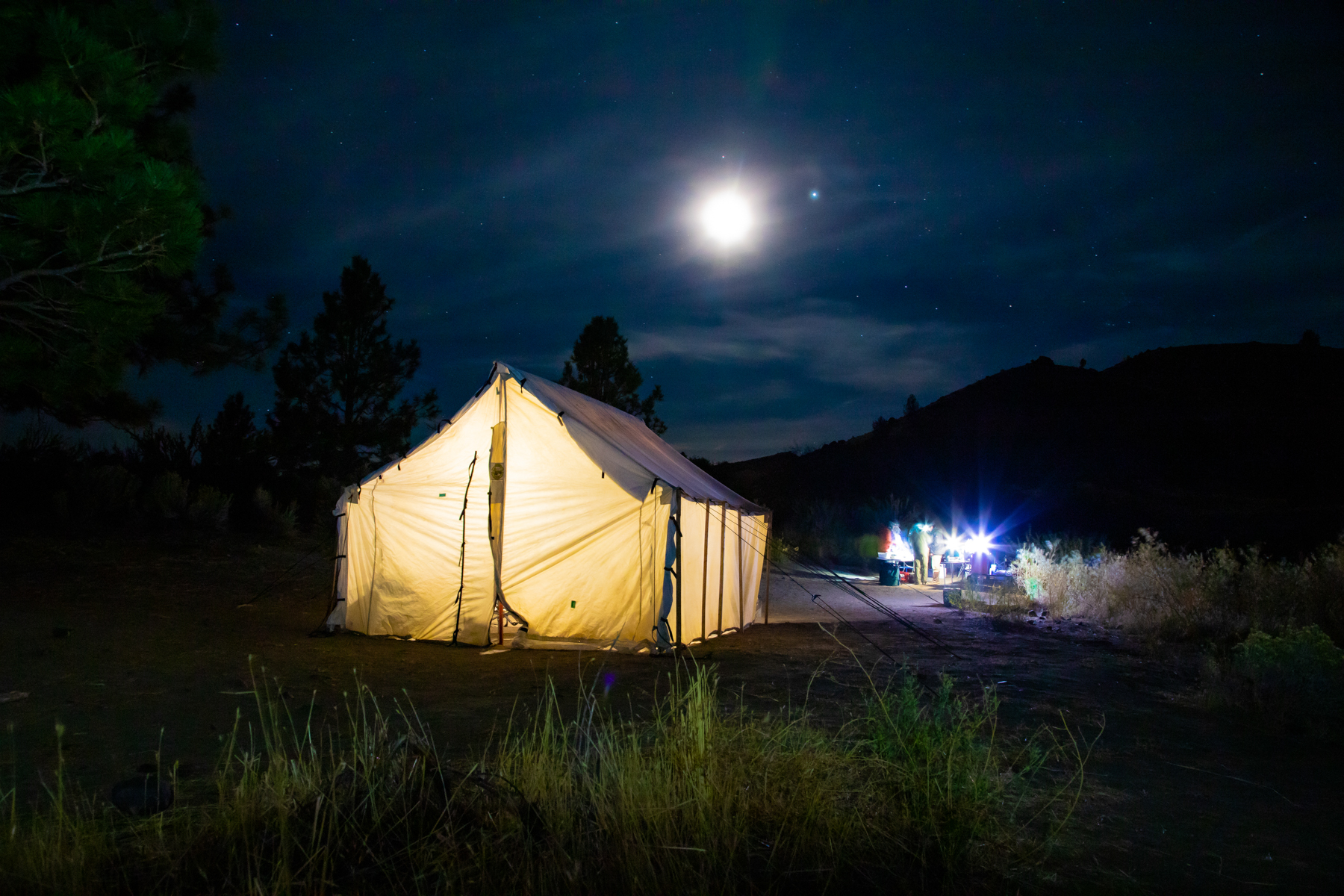
Mood is buoyant in camp. Chairs form a half circle against the water and iced coolers are visited repeatedly. A three-quarter moon has risen over the canyon rim and floods the canyon in a flat, ivory light. Drift boats are pulled up tight against the clay bank and tied off to exposed alder roots while our 17-ft Havasu looks as if it will need air again by morning.
We are encamped in the Park Camp, named from the park like short green grass found sparingly throughout the canyon and courtesy of grazing cattle that wander through camp at will. Two small raft camps up bank on our side and the sled camp across and down a ways are neighbors. Prime fly water runs nearly a mile on both sides of the river. Lockit, it’s called, Chinook jargon for 4 posted on the railroad sign up on the tracks.
It is late, now, everyone has straggled off to bed. The sounds of the canyon come alive in the silence: the breeze whooshing through the alder canopy, the cough of waves along the bank, the hissing of lanterns which I am just now extinguishing. I sit alone by the water a little longer, but eventually get up, turn on my headlamp and double check that everything is adequately wind and skunk-proofed, get my journal out of my boat, then follow the trail to my cot.
Stellar trip to date; three days in and everyone’s touched fish. Gordy wants to drop tomorrow, never mind we’ve been nailing them here. That’s just how it plays. Too many layovers in one camp and you’re behind the sticks, with one long-ass float going out. Fresh horizons beckon and the sled drivers having headed down river this evening is a good omen.
I set the alarm for 4:30 . . . unh; I am so not a morning person. Short break when I get home at least, five days off before three back-to-back trips, all lower canyon. Hope the fishing holds. Ledges on the morrow, then, looking forward to that.
Rob’s trip on the Deschutes with Ken, Dan, Kohn, Mike, Gordy and Don continues with Deschutes Journals Part 2: The Ledges.
***
Photography courtesy of Ken Morrish, Rob Lyon and Zento Slinger.